What is HODL?
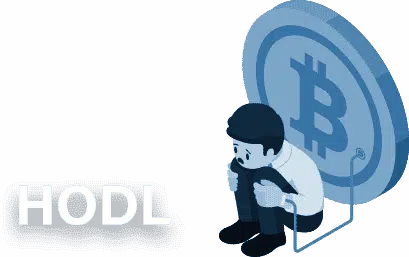
The year 2013 was a very volatile one for Bitcoin. The foremost cryptocurrency saw its price surge from around $15 a coin in January to a peak above $1,100 in early December of that same year.
It then quickly dipped to below $500 by mid-December. In the midst of all of this, an enthusiastic crypto investor, taken aback by happenings in the market, misspelt the word ‘HOLD’ as ‘HODL’ in a Bitcoin forum.
‘HODL’ instantly became a hit crypto slang referring to the long-term buy-and-hold strategy of crypto investing. The term has since been aptly retrofitted to mean ‘Hold On for Dear Life’. HODLers do not panic during periods of volatility or a bear market, as they believe in the long-term prospects of their crypto asset.
In recent years, there has also emerged a crypto token known as HODL. It is just another altcoin and bears no relationship with the famous crypto slang.
Open a Demo account to practice what you’ve learned or a Real account to start trading today!
What is the Meaning of HODL?
As mentioned, the term ‘HODL’ came about as a misspelling of the word ‘HOLD’. It is essentially an investment strategy or philosophy to invest for the long-term value of an asset.
The logic is straightforward: if you believe in the long-term value of an asset, you should not be too worried about short-term price fluctuations or medium-term price trends.
This buy-and-hold strategy is simple yet powerful. It is essentially a form of passive investing and eliminates the inherent risks of timing a market.
HODLing Stocks
Stocks are popular financial assets. HODLing stocks is essentially buying and holding them for a long time. Long-term stock investing can be done in 3 ways. First, there is growth investing, where investors focus on buying stocks of companies that are expected to expand in the long term. Examples of growth stocks include Apple, Netflix, and Facebook.
Secondly, there is value investing. Value stocks are those of companies that have been undervalued by the market compared to their underlying business fundamentals. Investors buy value stocks as they expect that value to be unlocked by the market over time.
Finally, there is dividend investing. Investors buy dividend stocks so as to maintain a more-or-less guaranteed source of periodic income over time. Holding stocks for the long term has proven to be profitable without the need to actively time their tops and bottoms. Stocks have historically maintained an uptrend over the long run.
HODLing vs Active Trading
As a strategy, HODLing has its pros and cons. The strategy is simple, time-saving, and attracts low costs. As well, HODLing has been proven to work in the crypto arena. For instance, Bitcoin traded for less than $1 in 2008, but by 2017, it traded for around $20,000. Of course, there were twists and turns, but for HODLers, patience pays.
But it can take a lot of time for HODLers to realise desired gains, and this can tie up capital that can be used to access other opportunities. In the short time that cryptocurrencies have existed, they have experienced devastating crashes that can take a lot of time to recover. HODLing through the market crash periods can expose investors to large losses.
In contrast, active cryptocurrency trading involves the buying and selling of assets according to market conditions. Cryptocurrencies are inherently volatile, and this can create numerous lucrative opportunities for active traders. Active trading also provides investors with great flexibility. That is, they can buy crypto assets when there is an uptrend and sell them when there is a bear market.
When trading actively, investors can also control their profits and losses – they can book or lock in profits when the market is going according to their prediction, or they can limit their downside if the markets go against them. However, active trading may be more costly because of the cost of opening multiple trade positions. Active trading is also a strategy that may not be ideal for beginners who are not well versed in technical and fundamental analysis.
Psychological Drivers of HODLing
Key Risks
• Past performance is not indicative of future results.
• Holding assets through volatile market swings may result in significant drawdowns.
Long-term holding decisions are not driven solely by market fundamentals. Psychological factors often underpin the resolve to “HODL” through booms and busts.
Recent research highlights how cognitive and emotional biases influence crypto investors’ behaviour, sometimes leading them to hold assets far beyond conventional exit points.
Common biases at play include:
- Loss Aversion: Investors feel the pain of a loss more acutely than the pleasure of an equivalent gain, making them reluctant to sell below their entry price.
- Anchoring: Traders may fixate on a purchase price as a “fair value”, even when market conditions have fundamentally shifted.
- Endowment Effect: Simply owning an asset increases its perceived value, encouraging extended holding.
- Fear of Missing Out (FOMO): Observing dramatic gains in social media or news can compel investors to remain invested in hopes of catching the next upswing.
- Herding Behaviour: Following the actions of peers or high-profile investors can reinforce the decision to HODL, irrespective of one’s own analysis.
These biases can be both beneficial and detrimental. On one hand, emotional discipline can prevent panic selling; on the other, it may blind investors to clear exit signals or changing fundamentals.
Practise controlling emotional biases in a risk-free environment—open a demo account today and experiment with long-term holding strategies.
What to HODL and When to HODL?
HODLing may be a simple, viable strategy, but not every crypto coin or token should be HODLed. It is important to look out for coins that have strong fundamentals and potential. Cryptocurrency prices are sometimes driven by hype, and this means targeting coins and tokens that have reasonable exposure. These are coins that are very liquid and have high market capitalisation, and ideally, they are exchange-traded. Coins that already have strong communities also have a decent chance of gaining traction because there are already investors that believe in their long-term potential.
When it comes to HODLing coins, the best time to HODL is anytime but ideally, to enter the market when prices are low. HODLing is based on a strong conviction of the long-term prospects of a coin, its utility or underlying project, as well as the broader potential of blockchain technology and the crypto ecosystem. Whether prices are trending higher or lower, HODLers are ready to play the patience game.
Tax and Regulatory Considerations for a Global HODL Strategy
Key Risks
• Regulatory ambiguity in your jurisdiction may affect tax treatment and reporting obligations.
• Non-compliance or inadequate record-keeping can lead to penalties.
1. Diverse Tax Regimes Across Jurisdictions
- Capital Gains vs Income Treatment: Many countries (for example, Australia, most EU states, Canada, Japan) treat disposals of crypto assets as capital gains, taxable at rates and allowances specific to each jurisdiction. Others—such as India or parts of Africa—may classify certain crypto activities (like mining or staking rewards) as ordinary income.
- Indirect Taxes: In some territories, value-added tax (VAT) or goods and services tax (GST) applies to certain token supplies or initial offerings, so long-term holders should account for any upfront or ongoing VAT/GST liabilities.
2. Reporting Obligations & Information Exchange
- Robust Record-Keeping: Across every jurisdiction, maintain a detailed ledger of your crypto transactions—dates, local-currency values, fees, and transaction types—to substantiate gains, losses and cost bases.
- Emerging Global Standards: From 2027, the OECD’s Crypto-Asset Reporting Framework (CARF) will require service providers worldwide to share user transaction data (exchanges, wallet transfers, payments) with domestic tax authorities, who in turn will exchange it internationally.
3. Regulatory Landscape & Jurisdictional Clarity
- Mature Markets: Regions such as the EU (under MiCAR), Switzerland, Singapore and Australia have well-defined licensing and supervisory regimes for crypto service providers, offering holders clearer guidelines on taxable events (trades, swaps, spending).
- Emerging/Evolving Markets: In many other jurisdictions, crypto rules remain fluid or absent. Sudden regulatory announcements—such as new definitions of “disposal” or reporting thresholds—can materially affect long-term holding outcomes.
4. Best Practices for Global HODLers
- Consult Local Authorities: Always verify the latest guidance from your national tax office or a qualified advisor familiar with digital-asset taxation.
- Leverage Exchange Reporting Tools: Use the downloadable tax-reporting and cost-basis tools provided by major exchanges, which increasingly support international formats.
- Stay Informed: Subscribe to updates from the OECD, FATF and leading tax-specialist firms (e.g. PwC’s Global Crypto Tax Report covers 59 jurisdictions) to anticipate legislative shifts
Timing Strategies and Exit Signals
Key Risks
• Relying on a single indicator can produce false signals, leading to premature exits.
• Extreme volatility may override technical or on-chain metrics, resulting in whipsaws.
Long-term holders can still benefit from disciplined exit strategies. By blending traditional technical indicators with on-chain metrics, you can identify high-probability signals to realise gains or rebalance without succumbing to emotion.
Technical Exit Signals
- Moving Average Crossovers
A shorter-term moving average (e.g. 50-day EMA) crossing below a longer-term average (e.g. 200-day EMA) often signals a shift into a downtrend and serves as an exit cue. - RSI Overbought/Oversold Levels
The Relative Strength Index (RSI) above 70 indicates overbought conditions, suggesting a corrective pullback may be imminent, while readings below 30 signal oversold extremes. - MACD Divergence
When price makes new highs but the MACD fails to confirm (bearish divergence), it frequently precedes trend reversals and offers a clear exit signal.
On-Chain Exit Signals
- HODL Waves Shifts
A thinning of long-term holding bands alongside a thickening of short-term bands on Glassnode’s HODL Waves chart highlights distribution phases where holders are cashing out. - RHODL Ratio Extremes
The Realised HODL (RHODL) ratio compares mid-term to short-term holder cohorts; exceptionally low values have historically coincided with market cycle tops, signalling opportune exit points. - MVRV Ratio Thresholds
An MVRV (Market Value to Realised Value) ratio above 2.0 (200%) indicates that holders are, on average, in substantial profit—often preceding market corrections and marking prudent exit levels.
Simple Do’s and Don’ts
- Do combine multiple signals—technical and on-chain—for confirmation.
- Do set automated alerts at your chosen thresholds rather than checking manually.
- Don’t chase market tops or double-down after a signal without further confirmation.
- Don’t ignore macro events; geopolitical and regulatory news can override technical and on-chain indicators.
Practise disciplined exits today—download the AvaTrade app and set up custom price and on-chain alerts to lock in your next profit.
Comparative Case Studies: Bitcoin vs Meme Altcoin HODL
Key Risks
• Past performance is not indicative of future results.
• High-volatility assets can suffer prolonged drawdowns—even after historic peaks.
Case Study A: Bitcoin HODL (2013–2021)
- Entry Point: 30 November 2013 at US $1,129.43, during the first major bubble that briefly took BTC above the US $1 000 mark.
- Peak Value: 10 November 2021 at US $68,991.85, driven by institutional adoption and the first wave of approved Bitcoin ETFs.
- Absolute Gain: ~6 000 % over eight years, equating to a 61× multiple.
- Notable Drawdowns:
- December 2018: slump to ~US $3 200.
- March 2020: COVID-19 crash to ~US $4 000.
- Lessons Learned:
- Patience Pays: Long-term conviction can smooth out short-term noise.
- Disciplined Rebalancing: Even BTC holders who sold small portions at local highs (e.g. 2017 peak) captured more than HODL-only peers through drawdowns.
Case Study B: Dogecoin HODL (2021)
- Entry Point: 1 January 2021 at US $0.00468, on the back of social-media hype and celebrity endorsements.
- Peak Value: 8 May 2021 at US $0.731578, a meteoric rise fuelled by retail frenzy and Elon Musk’s tweets.
- Absolute Gain: ~15 530 % in just four months (a 156× multiple).
- Subsequent Drawdown: By late 2021, DOGE fell back to ~US $0.20, erasing over 70 % of peak gains.
- Lessons Learned:
- Volatility Risk: Extreme upside can be followed by dramatic reversals.
- Timing Sensitivity: Short-term exits during parabolic rallies often safeguard more gains than an “always-HODL” approach.
Comparative Takeaways
- Time Horizon vs Event Risk: Bitcoin’s multi-year trend rewarded steadfast holders, whereas fast-rising alts like Dogecoin expose holders to sharper drawdowns if exit timing is missed.
- Diversification Imperative: Combining core positions (e.g. Bitcoin) with smaller, higher-risk altcoin allocations can balance potential returns and downside.
- Use of Exit Signals: As covered earlier, blending technical and on-chain signals helps capture profits and mitigate emotional decision-making.
HODL Coin
Named after the famous crypto slang, the HODL token is a rewards-based decentralised finance (DeFi) token built on the Binance Smart Chain. The token is designed to reward investors for HODLing their tokens. HODL is a yield farming and liquidity generation token. By yield farming, it means that your tokens earn interest. This interest is generated from HODL investors who decide to sell their tokens, and there is a small ‘tax’ applied for selling.
HODL token investors are rewarded with Binance Coin (BNB) tokens periodically. HODL token is also used to provide liquidity in the crypto markets, and this can also generate rewards for investors. The coin was launched in May 2021 with a supply of 1 quadrillion, and this explains its low price in the market.
Crypto Slang
HODL is one of the most well-known terms in the crypto world. But other slang names have gained notoriety. Here are some of them:
- FOMO (Fear of Missing Out): The urge to jump into bubbles for fear of regretting missing out on trending opportunities.
- Diamond Hands: Displaying the courage of HODLing even through extreme market conditions.
- Paper Hands: A belittling term referring to investors who refuse to display Diamond Hands during market turmoil.
- FUD (Fear, Uncertainty, Doubt): Negative headlines and misinformation that should be avoided by crypto believers as it creates fear, uncertainty and doubt for traders and investors.
- Mooning: The notion that a crypto coin or token will rise exponentially, i.e. prices will rise to the moon.
- YOLO (You Only Live Once): Take the risk and buy a crypto asset because you only live once.
- Whale: Investors that own a lot of cryptocurrencies. Their buying or selling activity can influence prices.
Final Word
HODLing is a simple yet very effective investment strategy that can generate massive returns for crypto investors. Sign up for an AvaTrade account and test your trading skills on a demo account, then trade on a live account. Plus, gain access to a wealth of effective resources and trading tools.
Why AvaTrade?
- Globally reputed broker regulated in multiple jurisdictions around the world
- Advanced mobile and desktop trading platforms with access to over 8 financial asset classes
- Attractive trading conditions, including low spreads, transparent prices and fast trade execution on all orders
- Comprehensive resources including AvaProtect, AvaSocial, and Trading Central
- 24/5 Professional support
Open a Demo account to practice what you’ve learned or a Real account to start trading today!
FAQ
- What is HODL and how did it originate?
HODL—originally a typo for “hold” in a 2013 Bitcoin forum post—has become shorthand for a long-term cryptocurrency holding strategy, emphasising conviction through volatility.
- Which psychological factors drive HODLing?
Key biases include loss aversion, anchoring to purchase price, the endowment effect and FOMO, all of which can reinforce a decision to hold rather than sell during market swings.
- What global tax and regulatory issues should HODLers consider?
Tax treatment varies widely—capital gains, income classification or VAT/GST may apply—so maintain thorough records and consult local guidelines or international frameworks like the OECD’s CARF.
- How can I determine the best time to exit a HODL position?
Combine technical indicators (e.g. moving-average crossovers, RSI extremes) with on-chain metrics (RHODL and MVRV ratios) to spot high-probability exit signals and avoid emotional trading.